
(930 words)
We’ve all been in that training session. Mindlessly clicking through a mandatory online training course while also checking email, shopping online, or scrolling through social media. That’s because too many trainings are painfully boring.
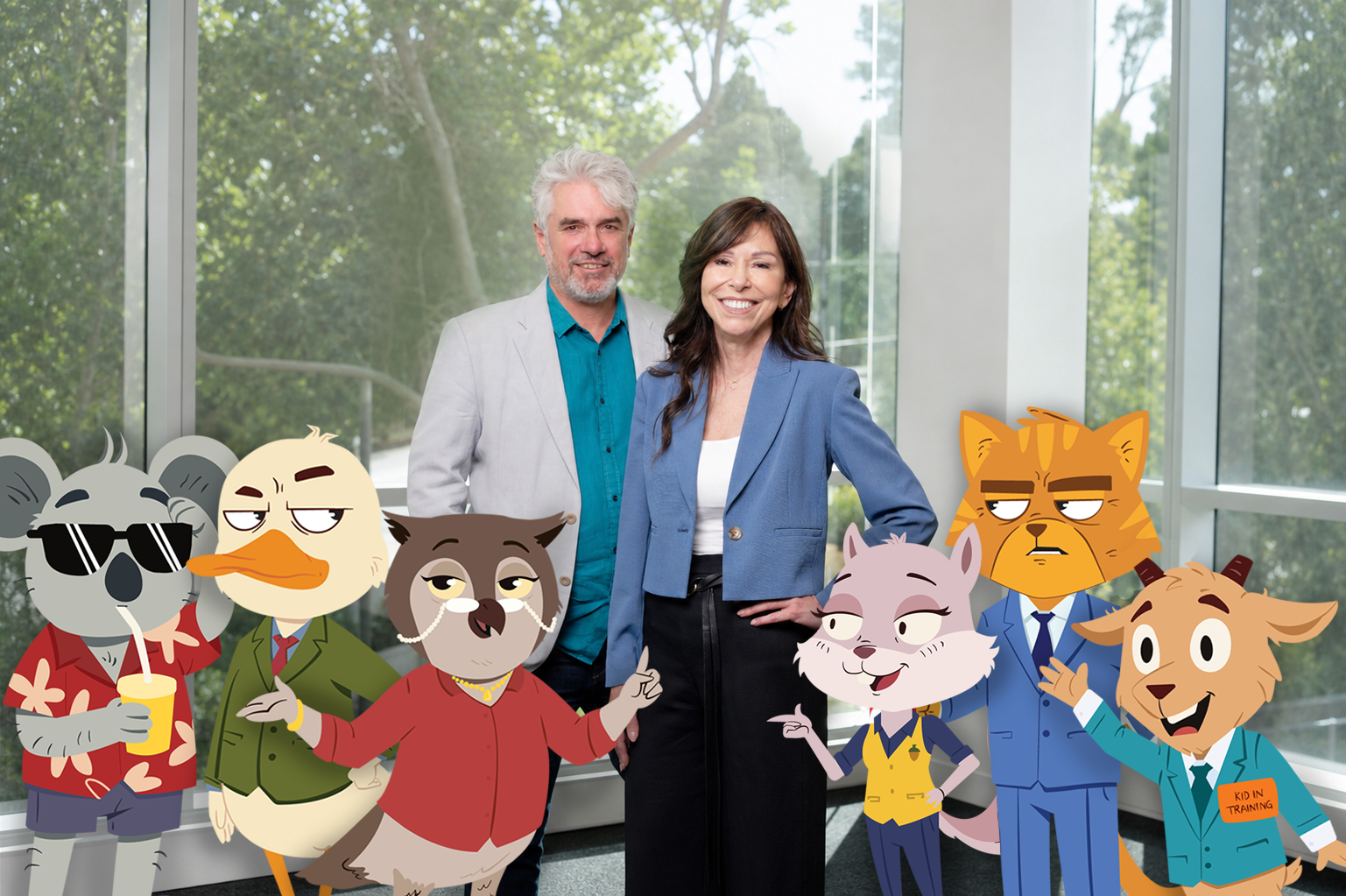
Christopher Balmford and Cinzia Theobald, the creators of The Plain Game, set out to change that. They’ve turned plain language training into an animated, story-driven game featuring a cast of memorable office animals.
From Dull to Dynamic Learning
For years, Christopher wanted to put his plain language training online, but something held him back.
“Online training is often so dull,” he said. “Really dull. Perhaps even notoriously dull. And because it’s so dull, it’s often ineffective.”
But an uplifting conversation with his son William, who has a Ph.D. in video games, sparked a new idea: What if the course became a fun game?
“A fun game that helped people learn about how to write in plain language would help deliver the benefits of plain language everywhere.”
The concept gained momentum when Christopher teamed up with Cinzia, who joined as Chief Operating Officer. Together they transformed the idea into a business plan, brought in others to help, and secured $1.5 million in investment.
“There was no turning back,” Christopher joked. “Gulp.”
A Game-Changing Approach to Multiple Challenges
The team set out to solve several challenges.
First, much online learning simply doesn’t engage people.
Second, despite valuing clear communication in theory, so many organizations continue to produce documents that confuse readers, waste time, weaken brands, and reduce organizational effectiveness.
In fact, a 2025 U.S. employer survey found that written communication is one of the top three most valuable job skills, with 77% of employers rating it as essential. Yet many workplaces still struggle to produce clear, reader-focused writing.
“The underlying problem,” Cinzia explained, “is that most people who write at work haven’t learned how to write in plain language.”
The team believes that a fun game engages people’s imaginations, making it more likely the learning will stick.
As Cinzia and Christopher shared: “Play is the brain’s favorite way to learn.”
Why an Office Full of Animals?
Lead writers for The Plain Game, Kate Sparkes and Paula Chiarcos, came up with the creative idea to set the game in an office populated entirely by animal coworkers.
The office setting was a no-brainer. This creates a world that feels fun, diverse, and instantly recognizable to office workers.
Making the staff members animals was less obvious. But animal characters make it easier to exaggerate familiar workplace personalities: the enthusiastic coworker, the well-meaning procrastinator, the person who resists every change, and others you’ll probably recognize from your own office.
One beta tester summed it up perfectly on LinkedIn:
“The game feels like a cross between Bluey and The Office.”
Christopher and Cinzia say that comment “made our day.”
Learning by Doing
Rather than presenting rules through endless slides and talking heads, The Plain Game puts players in realistic workplace situations.
Players solve communication problems, make decisions, answer quizzes, and receive feedback as the story unfolds.This interactive element, along with stories and humor, keeps people engaged. These features all help the learning stick.
Another beta tester appreciated the creative approach and “the chance to step away from the same-old, dry webinars and recordings and dive into a relatable cartoon scenario.”
As the tester added: “It’s a great late-afternoon pick-me-up!”
Who Should Play?
The Plain Game is for anyone who writes at work.
“If you use Microsoft Word,” Christopher said, “you’re writing.” And that means you have a reader and a purpose.
The goal isn’t to turn every player into a plain language expert overnight. Instead, the game helps people become stronger workplace writers while encouraging them to continue learning about plain language.
Those efforts go a long way, helping readers everywhere find, understand, and use information.
Collaboration Sparks Creativity
Creating the game required expertise well beyond plain language.
Over nearly two years, the team collaborated with storytellers, game developers, a comedian, a musician, editors, videographers, voice-over actors, a game studio, translators, localization specialists, and of course, plain language professionals. They even attended an international gaming conference.
The result is a training experience unlike anything most workplace writers have encountered.
Next Steps
The game just officially launched, so for now, the immediate priority is building a sustainable business. The team hopes to create more games on plain language topics—including document design, accessibility, evaluation, and ethical writing.
They also plan to license their gaming platform so other educators can transform traditional training into interactive learning experiences.
Increasing sponsorships, like the one they already have with the Center, is also on the horizon.
Play It!
Check out The Plain Game at ingamelearning.com. You can register for a free trial of the first topic of the game. The team is working on a Spanish version, which will launch in late 2026.
Reach out directly to the InGame Learning team at: https://wwwingamelearning.com/contact-us.
Let the games — and the clear communication — begin!
About the author:
 Shuly Babitz is a Senior Writer/Strategist and the Plain Language Lead at the US Department of Health and Human Services. She regularly presents on the principles and benefits of writing in plain language, particularly in Federal government.
The views expressed here are Shuly’s own and do not necessarily represent the views of HHS.