
Rolling with Report Cards
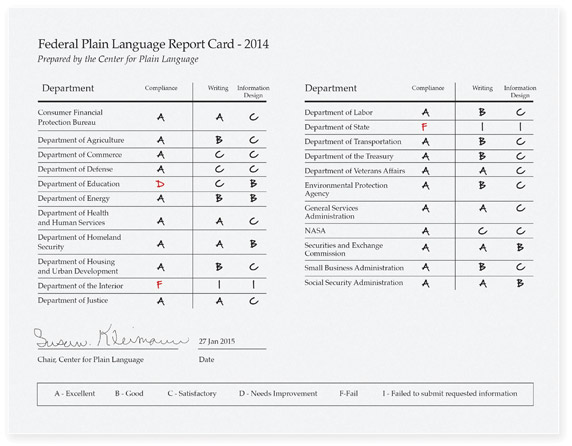
The Federal Report Card process for 2015 is underway! Agencies are preparing their submissions for the Center’s review. This relatively new service by the Center (since 2012) continues to evolve, and this year we are making a couple of changes to the process.
First, we are reviewing two types of documents, one selected by the Center and the other selected by the agency:
Questions from Plain Language students
In 2012, with the support of a Legal Services Corporation grant, LawNY (Legal Aid of Western New York) and Transcend (a language services company) offered a 10-week interactive online course, Plain Language Seminar for Lawyers.
Twenty lawyers from court systems and legal aid agencies across the nation signed up to learn more about plain language and to receive individual guidance with their active drafting projects.
Here are some of the questions posed during this class.
What you missed if you weren’t at the ClearMark Awards on May 12 – and why you shouldn’t miss it next year.
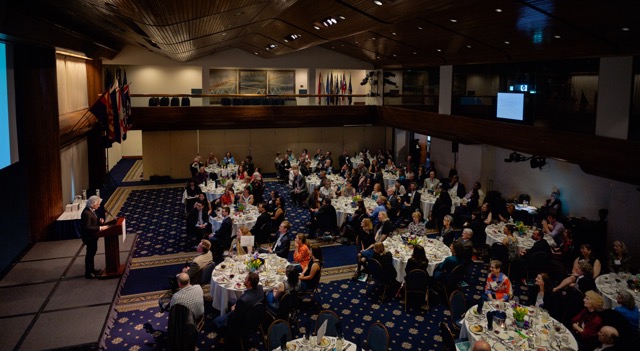
You attended the 2015 ClearMark awards at the National Press Club? That’s great!
What – You didn’t get there this year? Oh, no! Look at what you missed.
The Awards are coming! The Awards are coming!
Here’s an opportunity to spend a wonderful evening with other plain language advocates and practitioners. Each year, the Center for Plain Language gives the ClearMark Award to print and online information that is easy for the public to understand and use.
March Grammar Madness: Commas Win in an Upset!
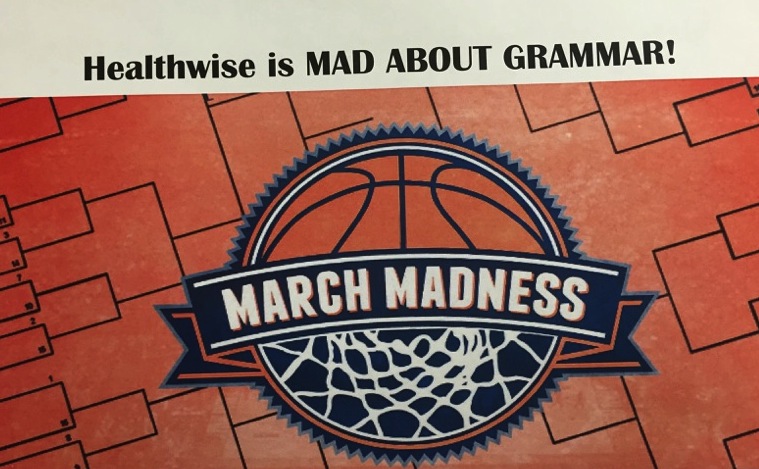
It’s March Grammar Madness at Healthwise. We’re mad about clear communication—and isn’t that the primary purpose of grammar?
So, just like the hoops fans who get into the college basketball spirit, we celebrated National Grammar Day (March 4) with a bracket. It’s all about sustaining the commitment to plain language—and scoring points with employees.
Love and plain language
I love my wife. I tell her so several times a day. When we wake up, on the phone, when we get home from work, before we drift off to sleep. The day just doesn’t feel complete without it.
On Valentine’s Day, however, we won’t do anything special. No office deliveries of long-stemmed red roses. No Hallmark greeting card with ready-made sentiments to express what I am (apparently) incapable of expressing on my own. And no making reservations at a hoity-toity restaurant weeks in advance to dine on an overpriced prix fixe menu.
Building a plain language culture in the US Government
I’ve spent the last few months working on the 2014 Federal Plain Language Report Card. The Report Card evaluates whether U.S. Federal Departments comply with the Plain Writing Act of 2010. This year we also analyzed writing samples against best practices for both writing and information design.
Writing for dollars
I work at a science-based regulatory agency. It can be tough to sell plain language to people who have graduate degrees in an area that I’m not a specialist in. The fact that I’m working with government scientists can make the pitch even harder. I’ve got two types of jargon and socialization to break through.
But one of the best things about working with scientists is that they trust expertise and evidence. If you give them evidence to prove your point, they tend to listen.
Filling the empathy gap: Learning to be clear in belgium
Each year, hundreds of passionate plain-language professionals from all over the world converge on a cool city to share the latest findings and advancements in our field. Vancouver, D.C., Lisbon, Sydney. You get the gist.
This November, a number of Center for Plain Language members and leaders traveled to Antwerp and Brussels for a joint conference hosted by IC Clear and Clarity.
Make your prose lean in 2015
At the start of a new year, like many of us, I groan with the post-holiday feeling of having eaten more chocolate and cheese—and exercised less—than I should. I feel the burden, real or imagined, of excess calories slowing me down. And now that the parties are over, the holiday candles back in boxes, the red and green sweaters safely stowed, I’m eager to refocus and trim down, leaner and sleeker than the year before.
Teaching Plain Language: 5 Challenges
One of my professional roles is to teach legal writing. And in spite of what you might think, most of us who teach legal writing try to teach law students to use plain language (to some degree or another). But term after term, I’m dismayed at the final assignments’ lack of plain language. So what’s standing in the way? I’ve identified 5 obstacles here, although I’m sure there are others. Whether you’re a plain-language coach, some other kind of teacher, or someone who’s just trying to get people to climb on the plain-language train, maybe some of the suggestions here will help. Although some of them focus on legal writing, I’m sure you can draw analogies to your own field.
December 4 webinar will help you prepare for the 2015 ClearMark Awards
The 2015 ClearMark Awards will be here before we know it — and we want to make sure you have all the details you need before the entry period begins on January 1, 2015. If you have questions about your nomination or the Awards in general, register for our first-ever webinar on Thursday, December 4 at 12:00 p.m. ET.
We’ll provide advice to help you ensure your application stands out — and has all the necessary information. And, we’ll have an open Q&A period where you can find answers to any lingering questions you may have.
Before and after: Describing a law — without legalese
Joe Kimble is a pleasant oddity. He’s a law professor and author who says the law presents less risk when it is written clearly. We followed his advice to redo this legal notice.
Look what can happen when you ask a few questions. Working with attorneys, we cut through the clutter of a 61-word sentence. The new version is easier for readers to grasp and use the information…
The time has come…
For me to depart from the Center’s Board. It’s been a terrific 10 years, but I need a rest and the Center needs a change of leadership.
We’ve gotten a lot done since we hosted our first big conference, the Plain International conference in Washington in 2005. We had over 300 people from 17 countries participate. The event set the trend for the bigger and better Clarity and Plain International Conferences we now enjoy…
Low health literacy… It could happen to you
It may be hard to believe that nearly 9 out of 10 adults in our country have trouble understanding everyday health information.
And it’s not always because they have not had much education, are aging or poor, or don’t speak English as their native language. There are so many reasons why people—people like you and me—may have low health literacy.